


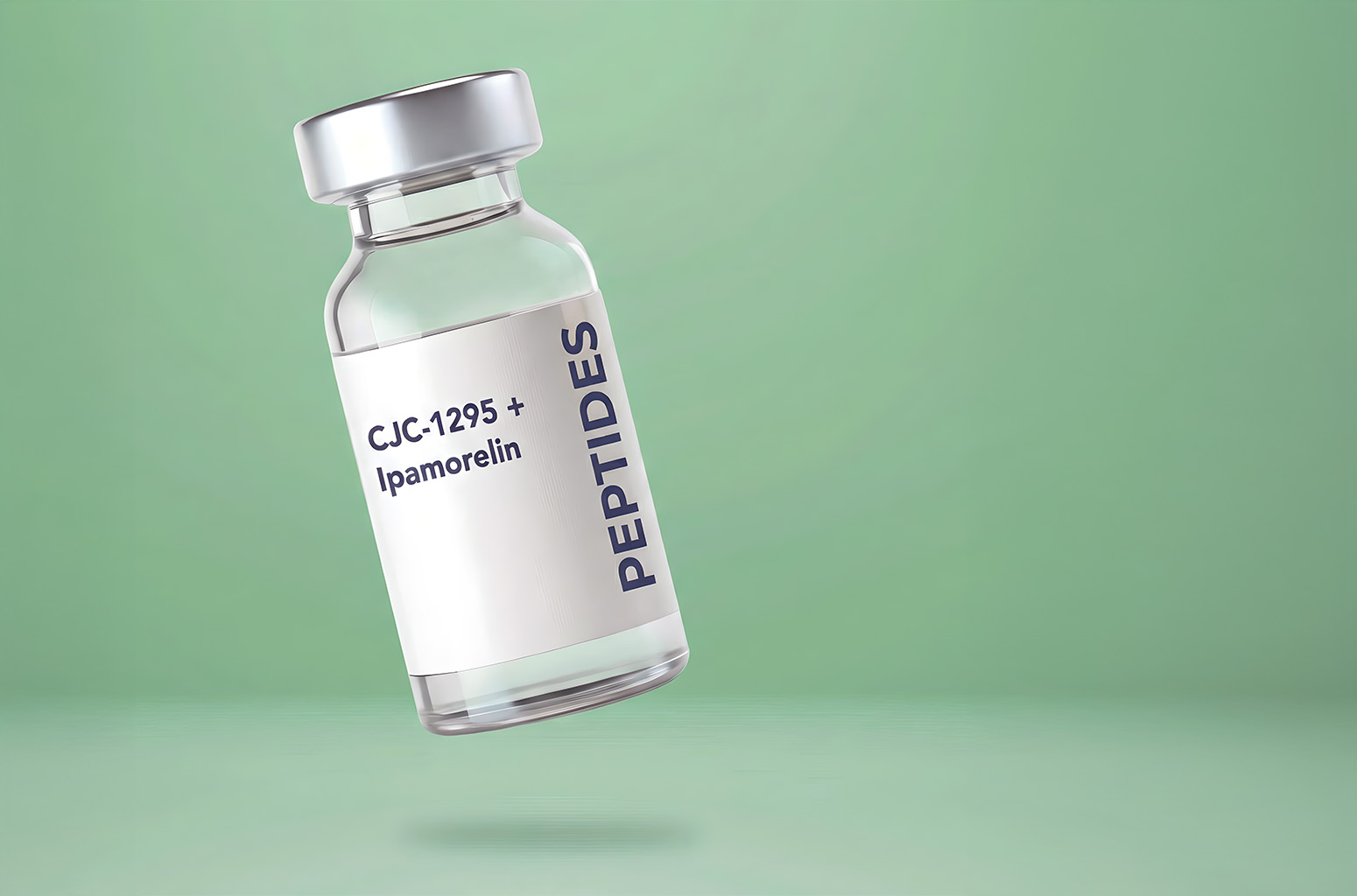
05 Feb CJC‑1295 and Ipamorelin: A Modern Approach to Growth Hormone Stimulation
Last update: February 5, 2026 | Author: Siri Napan, MD
CJC‑1295 and ipamorelin are growth hormone (GH) secretagogues used together to stimulate endogenous GH release and increase downstream insulin‑like growth factor‑1 (IGF‑1). Unlike exogenous GH, secretagogues act through intact hypothalamic–pituitary pathways, preserving negative feedback and physiologic regulation of hormone secretion 1. Understanding how these agents work, including formulation differences of CJC‑1295, is essential for appropriate clinical use.
What are CJC‑1295 and ipamorelin?
CJC‑1295 is a synthetic analog of growth hormone–releasing hormone (GHRH) that stimulates pituitary GH synthesis and release. Early human studies demonstrated that subcutaneous CJC‑1295 produces dose‑dependent, sustained increases in GH and IGF‑1 and is generally well tolerated in healthy adults 2.
Ipamorelin is a selective ghrelin (GHS‑R1a) receptor agonist. It promotes GH release primarily by inhibiting somatostatin, with minimal effects on cortisol and prolactin, distinguishing it from earlier GH secretagogues 1.
When combined, these agents act synergistically, producing a greater GH pulse than either agent alone while maintaining intact hypothalamic–pituitary feedback.
CJC‑1295 formulations: with DAC vs without DAC
CJC‑1295 with DAC
The DAC (Drug Affinity Complex) enables CJC‑1295 to bind albumin, extending its half‑life to approximately 6–8 days 2. This results in prolonged elevation of GH and IGF‑1 following a single injection.
Physiologic studies show that while GH pulsatility is preserved, basal (trough) GH levels rise substantially, contributing to increased mean GH exposure and higher IGF‑1 levels 3. This sustained exposure allows infrequent dosing but may increase the likelihood of GH‑related effects such as fluid retention or joint stiffness in susceptible individuals.
CJC‑1295 without DAC (Modified GRF 1‑29)
The non‑DAC formulation has a short half‑life (approximately 30 minutes) and more closely resembles native GHRH signaling. It produces discrete, pulsatile GH release rather than prolonged basal elevation.
Because of this pharmacokinetic profile, CJC‑1295 without DAC allows more precise timing with other secretagogues and closer alignment with physiologic GH secretion patterns. For combination protocols, this formulation is commonly preferred 1.
Dosing and administration
A commonly used clinical protocol for combination therapy includes:
- CJC‑1295 (without DAC): 200–300 mcg subcutaneously
- Ipamorelin: 200–300 mcg subcutaneously
- Frequency: Once daily
- Schedule: 5 days per week, with 2 days off to reduce receptor desensitization
Administration is frequently timed in the evening to align with physiologic nocturnal GH secretion. CJC‑1295 with DAC is generally dosed less frequently and is not typically incorporated into daily injection protocols.
Potential benefits
Through increases in GH and IGF‑1, these peptides may influence:
-
- Lean body mass and fat metabolism
- Recovery from musculoskeletal injury and disuse atrophy
- Connective tissue and cartilage biology
- Sleep quality
In orthopaedic and recovery‑focused literature, GH secretagogues are of interest due to their potential effects on satellite cell activation, protein synthesis, and collagen formation, though large clinical trials remain limited 1.
Safety considerations
Short‑term studies of CJC‑1295 show generally favorable tolerability, with no serious adverse events reported at studied doses 2. Potential side effects across GH‑based therapies include fluid retention, arthralgia, headache, and effects on glucose metabolism.
Because GH and IGF‑1 signaling have been implicated in cell proliferation and cancer biology, theoretical long‑term risks have been discussed in oncology and endocrine literature, though causality in clinical use remains unproven 4, 5. Long‑term safety data for peptide secretagogues in otherwise healthy adults are still limited.
Regulatory status
Neither CJC‑1295 nor ipamorelin is FDA‑approved for clinical use. Both are considered investigational agents, and their use is prohibited in competitive athletics. Existing GH and IGF‑1 guidelines emphasize cautious, evidence‑based application and highlight the need for further study as new hormone‑modulating therapies emerge 6.
Conclusion
CJC‑1295 and ipamorelin offer a mechanism‑based approach to stimulating endogenous growth hormone secretion, leveraging physiologic pathways rather than hormone replacement. Differences between long‑acting and short‑acting CJC‑1295 formulations have meaningful implications for GH signaling patterns, dosing frequency, and tolerability. While early studies and biologic rationale support ongoing interest in these peptides, their use remains investigational, underscoring the importance of conservative dosing strategies, careful monitoring, and continued clinical research.
Important Note: This guide is for educational purposes only and should not replace professional medical advice. Always consult with your healthcare provider before starting or stopping any medication. Individual results vary, and what works for one person may not work for another.
References
- Therapeutic peptides in orthopaedics: applications, challenges, and future directions. Journal of the American Academy of Orthopaedic Surgeons: Global Research & Reviews, 2026
- Prolonged stimulation of growth hormone (GH) and insulin-like growth factor I secretion by CJC-1295, a long-acting analog of GH-releasing hormone, in healthy adults. The Journal of Clinical Endocrinology and Metabolism, 2006
- Pulsatile secretion of growth hormone (GH) persists during continuous stimulation by CJC-1295, a long-acting GH-releasing hormone analog. The Journal of Clinical Endocrinology and Metabolism, 2006
- GH and IGF1 in cancer therapy resistance. Endocrine-Related Cancer, 2023
- Guidelines for growth hormone and insulin-like growth factor-I treatment in children and adolescents: growth hormone deficiency, idiopathic short stature, and primary insulin-like growth factor-I deficiency. Hormone Research in Paediatrics, 2016